Personalization in AI gaming uses a player’s skills, decisions, play style or stated preferences to change what happens next. It can adjust an enemy’s behaviour, offer a hint, choose a quest, shape a non-player character (NPC) response or recommend a game on a storefront. The test is whether that change serves the player.
Consider two predictions: one tells a game when you are ready for a tougher opponent; the other tells it when you are likely to buy a cosmetic item. Both depend on player data. They serve very different interests, even when the underlying AI looks similar.
What makes a game personalised?
Changing the difficulty yourself or designing an avatar is customisation. With personalisation, a saved preference, a rule or a player model makes the change for you. It needs information about an individual and a resulting difference in their experience. Manual choices should remain available when the automatic decision is wrong.
Rules, predictive models and generative AI solve different problems:
| Approach | What changes | Does it need generative AI? |
|---|---|---|
| Rule-based adaptation | Enemy numbers, hints or pacing after a defined event, such as repeated failed attempts | No. Designers write the conditions and responses. |
| Machine-learning personalisation | Recommendations, difficulty or player segments predicted from gameplay telemetry | No. Predictive models can select from existing content. |
| Generative AI | Dialogue, images, quests or character actions created or composed at runtime | Yes for generated output, but the output is personalised only when grounded in the player’s context. |
Procedural content generation (PCG) is another distinction worth making. A fixed seed can produce thousands of maps without learning anything about the person playing. No Man’s Sky shows what large-scale procedural world generation can do; its planets are not necessarily tailored to individual players. PCG becomes personalised when a player model influences the levels, layouts, challenges or rewards it creates.
How AI learns a player’s preferences
A game records telemetry such as mission completions, retries, time spent exploring, weapon choices, skipped dialogue, preferred modes, matchmaking results and interrupted sessions. Chosen difficulty, language and accessibility settings give a more direct signal than behaviour alone. Neither source explains every choice.
Developers can turn hundreds of those events into features in a player model: recent failure rate, exploration style or friction at a progression point. Clustering groups similar patterns. Supervised learning predicts outcomes such as mission completion, while recommendation systems use content features or collaborative filtering across players with similar histories. The model predicts behaviour; it does not know the player’s reasons.
Repeated boss attempts might mean a player enjoys mastery, not that they need help. A short session may fit a commute. Someone returning after a break might want a different kind of challenge. Estimates need regular updating, room for uncertainty and a clear rule that explicit choices override guesses.
The cold-start problem arises with a new player, game mode or item. There is not enough evidence for a precise profile. Broad defaults, an optional preference question and early feedback work better than treating a new account as though its interests were already known.
Where personalisation changes the game
Adaptive difficulty and pacing
Dynamic difficulty adjustment (DDA) changes enemy behaviour, health, resources, puzzle complexity, hints or encounter pacing in response to performance. A novice shooter player might get a longer reaction window; an experienced one might face more varied tactics. Players should still be able to understand why a fight became harder.
A racing game that makes every rival faster after a good lap can cancel the satisfaction of improving. Adaptation needs limits, predictable rules and a fixed-difficulty option. Ranked multiplayer calls for stricter separation: skill-based matchmaking can choose opponents, but it should not secretly rewrite match rules for individual competitors.
Quests, levels and personalised rewards
Adaptive PCG uses the player model within authored design constraints. Someone who likes finding hidden areas might get more exploration routes; a player who favours brief sessions might see shorter missions; someone who avoids combat might get alternative objectives. A recommender can make those choices from a curated quest and reward library, without generating new assets.
Generated quests still need navigable levels, reachable objectives, balanced rewards and a coherent place in progression. More content is not an improvement if the missions repeat themselves or break the game world. Designers can check geometry, difficulty limits, reward economies and narrative continuity before releasing an adaptive level.
NPC behaviour, memory and interactive storytelling
NPCs have long used dialogue trees, finite-state machines, behaviour trees and scripted reactions. In Middle-earth: Shadow of Mordor, the Nemesis System turns previous encounters into individual rivalries. That kind of reactive storytelling does not require a large language model (LLM).
A generative NPC can answer using the player’s words, quest state, character goals and memory of earlier interactions. Automatic speech recognition (ASR) handles spoken input; text-to-speech (TTS) voices the reply. Retrieval-augmented generation (RAG) can bring in approved lore and live game facts. The language model may write dialogue, but a behaviour tree or other game logic must still govern what the character can do.
Memory creates a harder boundary. An ally remembering a preference for stealth can be helpful. Keeping unrelated personal disclosures after a session is harder to justify. Character rules need to block invented quest instructions, promises the engine cannot fulfil and dialogue that breaks the established story.
Matchmaking and AI teammates
Personalised matchmaking selects a lobby, squad or opponent using skill estimates, connection quality, party size, region and queue time. A close skill rating does not cancel high latency or the advantage of a premade team. For UK players, server distance and ping still matter, no matter how sophisticated the matching model is.
An AI teammate has a different job: respond to spoken commands, recognise nearby threats and remember an agreed strategy. It must act quickly enough for the game, follow player instructions and stay out of real teammates’ way. A dependable response during a fight matters more than a long, convincing conversation.
Game discovery, LiveOps and in-game offers
Recommendation engines determine which games, modes, quests or social opportunities appear next. Steam’s Interactive Recommender uses playtime patterns to suggest games and lets people adjust discovery filters. Unity Analytics Audiences lets live-service teams work with segments such as new, recently active and churned players.
Live operations (LiveOps) teams also use predictive analytics for event scheduling, progression help and churn prediction. The same player segments can drive battle-pass offers, virtual currency, in-app purchases (IAP), paid cosmetics and advertising. Recommending a co-op event a player might enjoy is different from targeting a paid offer at someone immediately after a frustrating loss.

Session length and spending are not adequate measures of player benefit. Clear prices, stable progression rules and the option to reject promotional targeting matter particularly in free-to-play games.
Accessibility and personal control
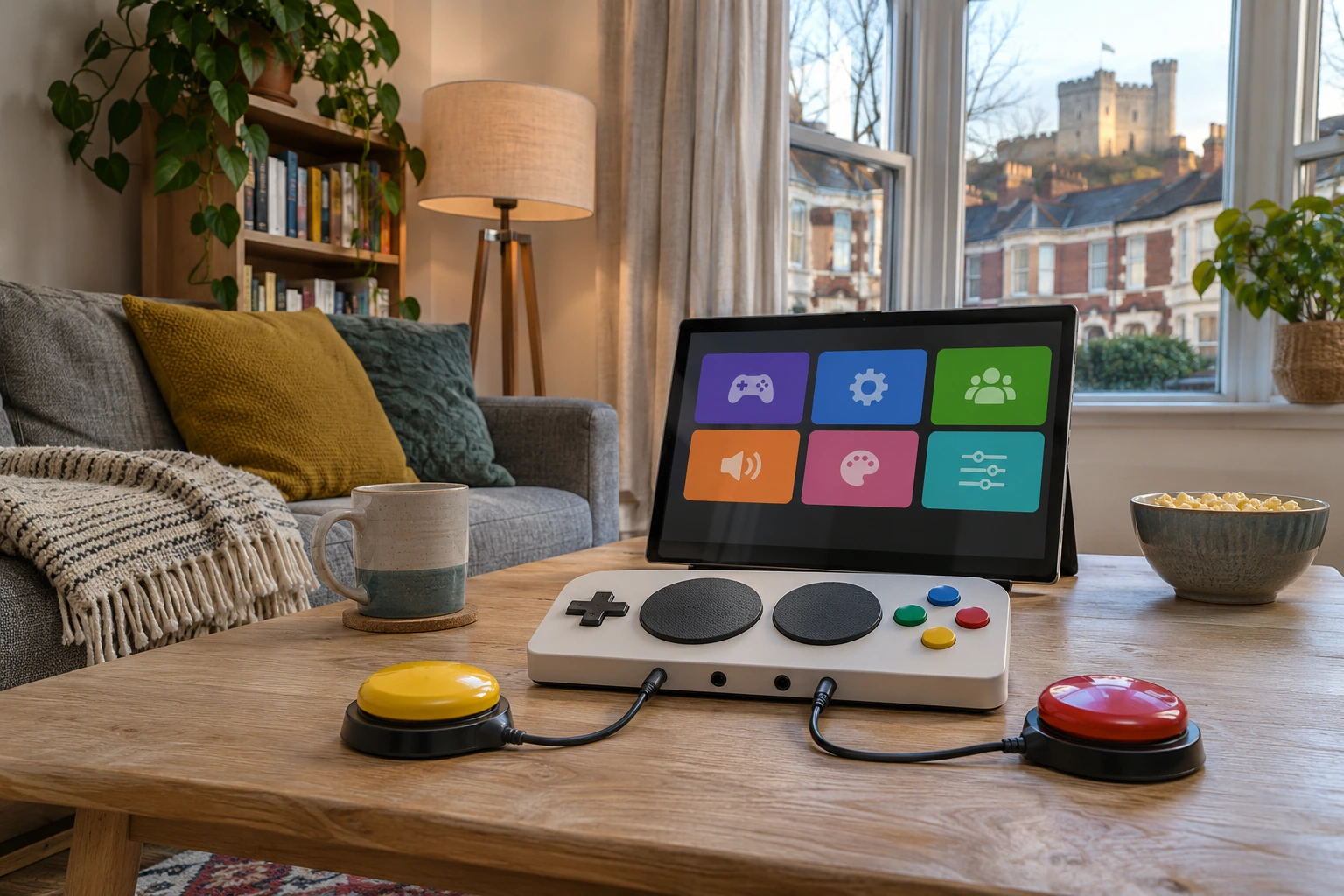
Adaptive subtitles, speech-to-text for voice chat, clearer interface layouts, remappable controls, adjustable timings and context-sensitive hints can make a game more accessible. Players need to know whether an assistive setting changes the interface, the controls or the difficulty, and should be able to choose.
An accessibility setting can disclose more than a player intends: motor-assistance controls, screen reading or speech recognition may reveal personal needs. Microsoft’s gaming AI accessibility guidance also flags generated levels that exclude disabled players and anti-cheat systems that misread assistive inputs. Manual overrides and tests with disabled players should happen before release.
What real gaming examples demonstrate
The examples range from released recommendation tools to experimental AI teammates:
| Game or system | Personalisation mechanism | What it demonstrates |
|---|---|---|
| Steam Interactive Recommender | Machine learning trained on playtime patterns, with adjustable discovery filters | Personalised game discovery, not a game rewriting itself |
| Forza Drivatars | Driving-style data from players used to shape AI racing opponents in earlier Forza Motorsport titles | Player modelling can influence opponent behaviour; newer Forza Motorsport AI uses a different training approach |
| Middle-earth: Shadow of Mordor | Nemesis System tracks encounters and adapts rival characters | Reactive stories do not require generative dialogue |
| PUBG Ally | KRAFTON and NVIDIA ACE combined voice recognition, a small language model, game-state context and memory | A 2026 public beta demonstrated a context-aware AI squadmate, not a universal feature of PUBG |
| Ubisoft Teammates | Voice-controlled, generative companions operating inside authored narrative boundaries | A closed-playtest research experience, not a generally released game |
Forza’s own development notes separate the older player-style Drivatars from opponents trained differently for the newer Motorsport release. KRAFTON’s PUBG Ally technical account describes distinct systems for rapid action and language reasoning. Ubisoft’s Teammates project keeps character motivations and narrative boundaries in designers’ hands.
How a personalisation system works behind the scenes
Between observing a player and changing the game, a system makes six decisions:
- Observe: record necessary gameplay events, selected settings and immediate game state. Keep account identifiers separate when they are not needed for a particular decision.
- Interpret: convert events into features, such as recent attempts, exploration rate or preferred game mode. Estimate uncertainty and detect changes in behaviour.
- Select: use authored rules, a predictive model, a recommender or a reinforcement-learning policy to choose a permitted change.
- Constrain: apply game-design limits, safety rules, fairness checks, accessibility requirements and player-selected settings.
- Deliver: update an existing mission or interface, select an item or generate a response. Local inference can reduce network round trips; cloud inference changes latency, operating cost and data handling.
- Evaluate: check whether the change helped, caused confusion or pushed players towards unwanted behaviour. Update the model only when the evidence supports it.
The right tool depends on the task. Fixed rules can balance a predictable encounter. A recommender can choose among hundreds of authored quests. A generative model suits open-ended dialogue that designers cannot script in advance. Each option has different validation demands, latency and operating costs.
When personalisation makes gaming worse
Player behaviour does not always reveal what the player wants.
| Warning sign | Underlying problem | Better design |
|---|---|---|
| Every win triggers stronger enemies | Difficulty adjustment erases mastery | Cap adaptation, explain difficulty choices and offer a fixed mode |
| Only familiar genres are recommended | Feedback loops narrow discovery | Include exploration and user-adjustable recommendation filters |
| An NPC invents a mission or breaks character | Ungrounded generative output | Use approved game state, lore retrieval and action validation |
| Players with assistive devices are flagged | Biased detection and missing accessibility tests | Test assistive inputs, provide appeals and preserve human review |
| Offers appear after a frustrating loss | Behavioural targeting exploits a vulnerable moment | Separate support recommendations from monetisation decisions |
| A new player is treated as a known profile | Cold-start uncertainty and weak data | Use safe defaults, explicit choices and cautious early adaptation |
Generative NPCs add the risk of invented information, unsafe dialogue, inconsistent lore and biased output. Inference latency and running costs also matter. When players cannot tell why a rule changed, even a technically clever adjustment can feel less fair than a fixed one.
Privacy and player protection in the UK
In the UK, identifiable player telemetry and profiling are subject to the UK GDPR and Data Protection Act 2018. Teams should define a clear purpose, collect only data needed for it, explain the use to players and set sensible retention and access controls. The Information Commissioner's Office provides guidance on personal information and AI.
Gameplay patterns do not by themselves diagnose a player's health or intentions. Models should be tested for false positives and unfair outcomes.
How to tell whether personalisation is working
Choose measures that reflect the player’s goal. In an adaptive tutorial, count successful completion after appropriate practice rather than extra minutes online. For discovery, measure whether recommended games lead to satisfying sessions, not merely store clicks. For AI companions, check whether valid requests receive correct actions quickly enough for gameplay.
| Player goal | Useful outcome | Guardrail |
|---|---|---|
| Learn a difficult mechanic | Successful completion after appropriate practice | Player-rated challenge and retained sense of achievement |
| Find a game or mode worth playing | Chosen recommendations that produce enjoyable sessions | Genre diversity and user control over filters |
| Receive useful NPC assistance | Correct, timely responses to in-game requests | Latency, invalid actions and unsafe or off-topic dialogue |
| Play balanced multiplayer matches | Competitive match quality and fewer premature exits | Ping, queue time and fairness across player groups |
| Get accessible assistance | Task success with the player’s chosen controls | Privacy, false anti-cheat flags and unwanted automatic changes |
A controlled A/B test can compare personalisation with an unchanged game while monitoring satisfaction, accessibility, complaints and spending pressure. Day-one and day-seven retention, progression funnels, churn rate and session length can help diagnose behaviour; they are not proxies for wellbeing. Higher purchases alongside more complaints about pressure would be a warning, not a win.
Questions players and developers ask
Is adaptive difficulty the same as AI personalisation?
Yes, adaptive difficulty is one form. It may use rules rather than machine learning; AI personalisation can also alter NPC interactions, quests, recommendations, matchmaking and accessibility support.
Does personalisation require an internet connection?
No. Rules, a local player model or a small on-device AI model can adapt an offline game. Cloud recommendations, shared profiles and large language-model services generally need a connection. Licensing and save-system requirements can still prevent offline play.
Can players turn personalisation off?
Not always. Games vary in what they let players disable. Useful controls separate core gameplay adaptation from optional tracking, tailored offers and AI chat. Fixed difficulty, recommendation filters and profile-reset or privacy settings give players some control back.
Does a personalised NPC remember everything a player says?
No. An NPC can respond using short-term context without saving the conversation after a session. Persistent memory requires a storage and deletion policy. Remembering that a player prefers stealth is different from keeping personal details unrelated to play.
What separates helpful AI from manipulative personalisation?
A useful system follows the player’s goals within fair rules and offers real control. A manipulative one predicts vulnerable moments to create spending pressure or hides changes to difficulty. The deciding factor is what the model is trying to achieve, not how impressive its replies sound.