
A rising jackpot meter shows the size of a prize, not when your next spin will win it. A jackpot might be a fixed award, a pool funded by qualifying bets, or a randomly triggered prize attached to several games. The rules for its trigger, eligibility and payout matter more than the headline number.
What counts as a jackpot?
A jackpot is a named prize awarded under a defined set of game conditions. In a slot machine or online slot, it can sit alongside ordinary line wins, free spins and other bonus features. It may be paid as a fixed multiple of the total bet, a fixed cash amount or the current value of a growing pool.
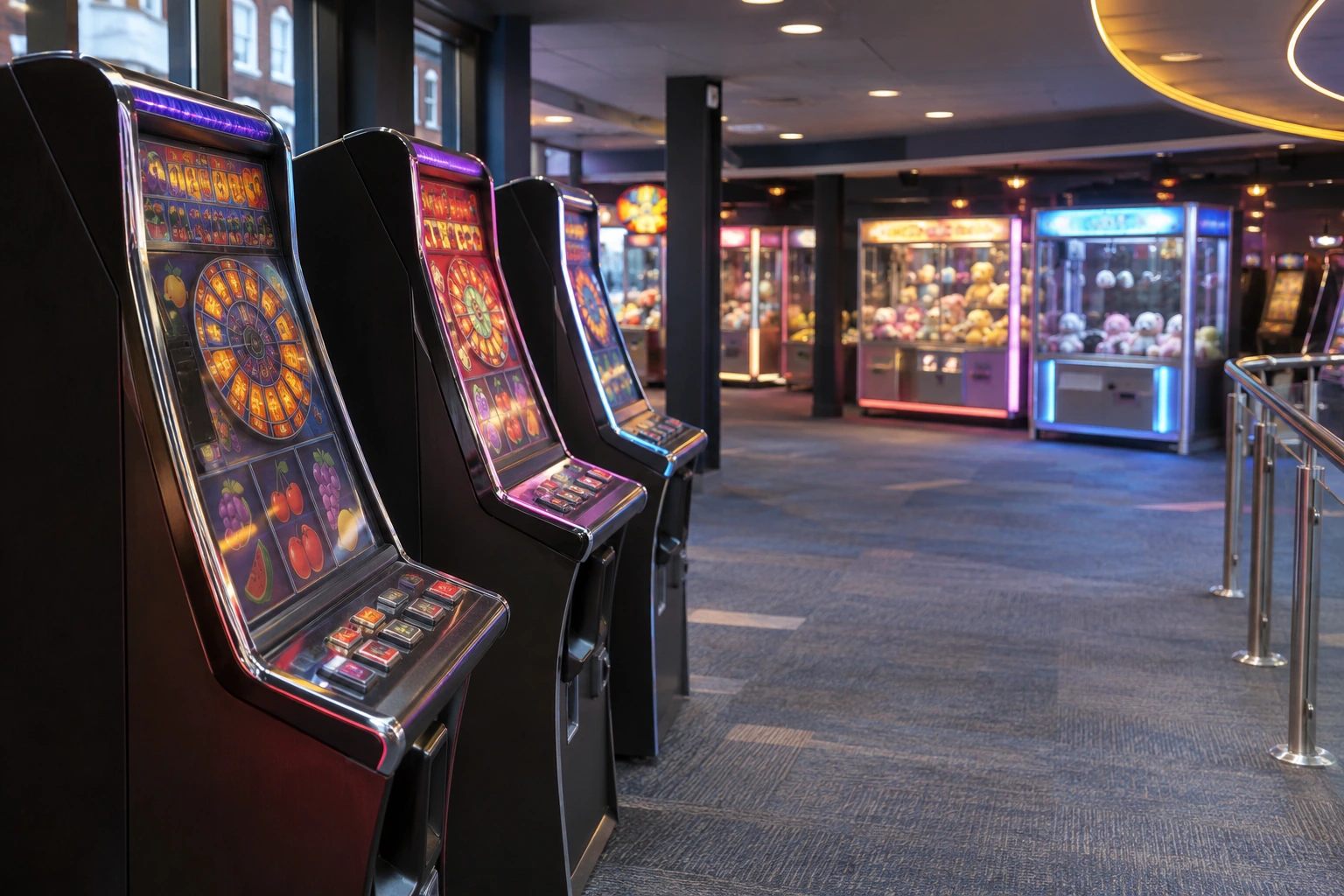
Three figures that often appear together do different jobs. The paytable shows ordinary symbol payouts and feature awards. A jackpot meter displays a named prize, sometimes updating as eligible bets contribute to it. The maximum win, such as 10,000× the stake, is a cap on the game's payout under the relevant rules. A maximum win is not automatically a jackpot.
A slot can offer a Grand jackpot worth 1,000× the bet and a different overall maximum win. Another slot can advertise a 10,000× maximum without having any jackpot feature. The names and units on the game information screen settle the distinction.
Fixed, progressive and mystery jackpots
Fixed jackpots
A fixed jackpot has a predetermined value or payout formula. A Mini prize worth 20× the total stake remains 20× even after thousands of other spins. The cash payout changes with the stake: 20× a £1 bet pays £20, while 20× a £2 bet pays £40. Fixed does not mean frequent or easier to win.
Progressive jackpots
A progressive jackpot starts from a funded amount and grows according to the game's contribution rules. One or more prize tiers can rise independently. After a valid win, the awarded tier normally returns to a defined seed or reset value and starts a new cycle. A progressive pool can be linked to a single machine, several games or an entire participating network.
Mystery and must-hit-by jackpots
A mystery jackpot is triggered by a separate random process rather than a visible combination of jackpot symbols. Some systems select a hidden prize threshold when the pool resets. The jackpot drops when eligible activity takes the meter to that threshold. Other mystery systems use a random event on a qualifying play.
Must-hit-by describes a condition, not a prediction. A jackpot advertised as dropping before its meter reaches £1,000 has an upper boundary for that prize cycle. It can still be awarded well before that point, and the displayed amount does not identify which player or spin will receive it. Time-limited, daily-drop and hourly jackpots use their own award windows and eligibility rules; the label alone does not reveal the probability.
Where does the progressive jackpot money come from?
Many progressives divert a stated portion of qualifying wagers into a prize pool. The contribution can be included in the total bet or described as a separate amount. Some systems distribute it across Mini, Minor, Major and Grand tiers; others maintain a reserve to fund future reset amounts. The current prize shown on screen need not equal all contributions ever collected.
Consider an illustrative progressive with a £500 seed, a £2 qualifying stake and a 1% contribution to the visible pool. Each eligible spin adds £0.02. Across 1,200 such spins, the pool receives £24 and reaches £524, provided no prize is awarded and there are no other additions. The 1% is an example for the calculation, not a standard rate for jackpot games.
A ceiling sets a maximum displayed jackpot value when the product has one. Once it is reached, extra contributions may be routed to an overflow or reserve account under the applicable rules. A ceiling is not necessarily a must-hit-by threshold: some products stop increasing the meter and continue waiting for the defined winning event. The game's jackpot rules must distinguish those behaviours.
Standalone, local and network jackpots
The number of participants feeding a jackpot affects how quickly money can enter the pool. It does not, by itself, establish the chance that one qualifying spin wins.
| Structure | Who contributes? | What changes? |
|---|---|---|
| Standalone progressive | One gaming machine or game instance | The pool grows only from its eligible play and any other specified funding. |
| Local or linked jackpot | Several machines, games or instances at a defined venue or operator | Participants share a jackpot and compete under common award rules. |
| Network or multi-site progressive | Connected venues or participating online platforms | More sources can contribute to the same pool; settlement is managed across the network. |
A single slot theme may exist in both ordinary and jackpot-enabled editions. A jackpot controller can run separately from the underlying game, while a remote game service reports eligible wagers and results. Two games with similar reels need not share the same pool, contribution rate, RTP or qualifying stake.
What triggers a jackpot win?
The random number generator (RNG) supplies random outcomes for digital games. Which outcome awards a jackpot is defined by the particular game or linked jackpot system. A spinning animation is a presentation of that result, not a reliable way to predict it.
- Reel or symbol trigger: the correct jackpot symbols land on eligible reels, paylines or patterns. Wild or scatter symbols have the roles stated in the paytable.
- Bonus feature: a special combination opens a wheel, pick-and-reveal game or hold-and-spin feature. A Collect symbol or matching three jackpot icons may award a named tier.
- Mystery trigger: an external jackpot service or controller chooses a qualifying event or hidden threshold. The win can appear during an otherwise ordinary spin.
- Side-bet or table-game trigger: an eligible poker hand, bad-beat condition, video-poker royal flush or table-game side wager can unlock a separate jackpot.
Bonus features can mix mechanisms. A tier-selection wheel might contain fixed prizes while a separate top tier is progressive. A hold-and-spin feature can pay a fixed jackpot without feeding a network pool. A feature's name cannot substitute for its rules.
Real products illustrate the differences: Pragmatic Play's Jackpot Play is a local progressive feature with four tiers, while its Power Jackpot uses a networked model with a community award component. Games Global's Mega Moolah family features progressive tiers. Those designs illustrate different funding and award arrangements; their appearance in a catalogue does not establish availability in the UK.
Mini, Minor, Major and Grand: what the tiers mean
Jackpot panels commonly use labels such as Mini, Minor, Major, Mega, Grand or Power. They identify prize levels inside that game, not a universal scale. A Mini can be fixed while a Grand grows progressively. Another game may make every tier progressive, with each tier carrying its own seed, pool, contribution rate and winning probability.
Lower tiers are often configured to award more frequently than the top tier, but the label does not provide a hit frequency. One Grand may be won through a bonus selection, another through a hidden threshold. A tier that resets while others keep growing has its own prize cycle; it does not reset every linked jackpot automatically.
Does bet size change jackpot eligibility or odds?
The qualifying wager is one of the most consequential details in a jackpot game's rules. Some games allow any paid spin within the supported bet range to enter the draw. Others require a minimum stake, an active side bet, a particular denomination or a specified bet level. A higher stake can increase a stake-multiplied fixed prize without changing the chance of triggering it.

Maximum bet is not a universal jackpot requirement. Where a maximum stake is required, the rules should say so. In another game, every eligible stake can win the same progressive amount. Some mechanics weight entries or probability by stake; others do not. A bet-size change has no reliable mathematical interpretation without the exact paytable and eligibility conditions.
Free spins and bonus buys require equal care. A jackpot may be unavailable during promotional free spins, active only in the base game, available in a particular bonus round, or simulated in demo mode. A demonstration balance does not prove that a real-money network pool or jackpot payout is active. The edition, currency, game mode and stake must match the displayed prize conditions.
How RTP, house edge and volatility relate to jackpots
Return to player (RTP) is the theoretical proportion of stakes returned as prizes across a very large number of plays. A 96% theoretical RTP corresponds to £96 of expected prize value per £100 wagered across the mathematical model, not a promise that a £100 session returns £96. The remaining 4% is the theoretical house edge, before any distinctions made in the published RTP basis.
A jackpot component may be included in the stated RTP or shown separately from base-game RTP. A progressive contribution can transfer some theoretical return into rare, high-value awards rather than ordinary line wins. Two games labelled 96% are not directly comparable unless both figures include the same features, qualifying bets and jackpot component.
Volatility describes how unevenly wins are distributed. Jackpot games can have high variance because a small share of outcomes carries a large part of the total return. A high displayed jackpot does not establish the chance of hitting it, and a long losing run is compatible with a published theoretical RTP below 100%. Hit frequency, jackpot odds and RTP measure different aspects of the game; none can be calculated from the size of the meter alone.
Can a growing jackpot become easier to win?
Some jackpot triggers have a constant probability per eligible event. The amount displayed can rise while the trigger chance stays the same. Under a hidden-threshold must-hit-by design, the conditional chance of a drop may change as the meter approaches the allowed boundary. The actual model, pool increment and eligible participants determine that change.
Neither design establishes that a particular player is next. A networked jackpot can be awarded to another participant before a local spin completes. Past losses do not create an unpaid balance owed to a machine, and an earlier jackpot win does not put a slot into a fixed cooling-off period unless the game's rules explicitly contain such a feature.
Claims that a jackpot is “hot”, “due” or guaranteed to reward a player near its ceiling confuse the pool's current value with the outcome of an individual wager. A must-hit-by rule guarantees an award within the specified product boundary, not a win for everyone participating near that boundary.
Jackpots in Great Britain: casinos and online slots
In Great Britain, check the operator against the Gambling Commission public register and read the specific game rules. Published return figures, payout schedules, jackpot eligibility and player controls can differ between games and versions. A mathematical model or laboratory test does not establish that an operator is licensed.
Mathematical probabilities and expected returns cannot predict an individual session or eliminate the risk of losing money.
The six details that make a jackpot understandable
A useful jackpot information screen answers six practical questions: which prize is being offered; whether its value is fixed or progressive; which bets qualify; what triggers the award; how the current pool, seed and ceiling work; and whether the published RTP includes the jackpot component. For a network prize, it should also identify the participating scope and how simultaneous wins or interrupted games are settled.
A jackpot meter without these details shows only the advertised prize state. It does not reveal the cost of eligibility, the probability of an award or the real payout conditions. The highest number on the display is often the least informative number for interpreting the game.
Jackpot questions answered
Can a jackpot pay twice in quick succession?
Yes, when the rules permit separate winning events after a reset. A prior win does not prove another award is either imminent or impossible. Each tier follows its own trigger and reseeding rules.
Can a free-spins round win a progressive jackpot?
Only when that game and bonus mode explicitly allow it. Free spins, promotional spins and bonus features can have different jackpot eligibility from ordinary paid spins.
Do all players share one progressive jackpot?
No. Some pools belong to one machine or game; others are shared within a venue, operator or permitted network. The game edition and the jackpot controller's participation rules determine which players are connected.
What happens if two players trigger a jackpot at nearly the same time?
Linked systems use settlement and event-ordering rules to identify the eligible winning event or handle simultaneous claims. The result cannot be inferred from the animation on either player's screen. The relevant prize-system rules govern the award and any subsequent reset.
Are jackpots restricted to slot machines?
No. Progressive prizes can also attach to video poker, poker bad-beat awards or eligible side bets in table games. The odds, qualifying conditions and contribution mechanisms follow that product, not the slot model.
Where is help available if jackpot play is becoming difficult to control?
Gambling can cause harm. For information about gambling support in Great Britain, see the NHS gambling support guidance.