
A 10× multiplier does not pay ten times the stake. It applies to the eligible prize defined by the rules: perhaps one payline, a cluster, a tumble sequence or the total from a bonus spin. No qualifying win, no multiplier payout.
Free spins, respins and sticky wilds change the playing conditions, not necessarily the value of every win. Trigger, qualifying prize, stacking rule and expiry determine how their payouts work. The largest number on the reels reveals none of these.

What does a multiplier actually multiply?
Paylines, adjacent-reel ways, clusters and pay-anywhere grids determine whether a group of symbols wins. The paytable prices that combination against the stake; only then does an eligible multiplier change its value.
On a £2 spin, a £0.40 line win with a 5× multiplier pays £2. That matches the stake before any other payouts. The spin has not won £10 just because the multiplier reads 5×.
Now add a second, unmultiplied line worth £0.60. When the 5× applies only to the first line, the total is £2.60: (£0.40 × 5) + £0.60. A global 5× applied to both lines gives £5 instead. The paytable decides which calculation applies.
The six rules that determine a multiplier's value
Random refers to how a multiplier is chosen; persistent refers to how long it stays active. A value may be random and carried by a wild, or progressive and persistent through free spins.
| Rule | What it controls | Question to resolve |
|---|---|---|
| Trigger | How a multiplier becomes active: a special symbol, winning cascade, random modifier or bonus mode | Must a paying combination occur first? |
| Scope | Whether it affects a line, way, cluster, reel position, full spin or bonus-round total | Does it apply to every prize or only one? |
| Value | A fixed 2×, a randomly selected number or a value that grows as conditions are met | Can its value change after appearing? |
| Combination | Whether simultaneous values are added, multiplied or applied to separate wins | Do 2× and 3× become 5× or 6×? |
| Duration | One combination, a spin, a cascade chain or several free spins | Does the value carry over? |
| Limit | A maximum multiplier, feature cap or maximum win expressed as a stake multiple | Can an advertised multiplier be paid in full? |
A fixed multiplier keeps the same value whenever it qualifies. A random multiplier draws from the game's permitted values; an increasing or progressive multiplier grows after specified events. A persistent multiplier survives across stated spins or tumbles. A position multiplier stays on a grid square, while a wild multiplier follows a winning combination involving that wild.
Do multiple multipliers add or multiply?
Even when 2× and 3× wilds join the same £1 win, the resulting payout depends on the game's stacking rule.
| Multipliers on the same qualifying win | Additive rule | Multiplicative rule |
|---|---|---|
| 2× and 3× | 5× = £5 | 6× = £6 |
| 2×, 3× and 5× | 10× = £10 | 30× = £30 |
| 4×, 4× and 4× | 12× = £12 | 64× = £64 |
These figures assume that all multipliers apply to the same £1 base prize and that no cap intervenes. Wilds on separate paylines may modify separate prizes, even if both values are visible together. Some games collect multiplier symbols and apply their sum after the last tumble; others change the factor between individual winning cascades.
A multiplier that has appeared is not necessarily a multiplier that has become payable. An orb, wild or multiplier meter may show a large number without producing a prize until a qualifying combination lands.
How bonuses interact with base-game wins
Free spins and retriggers
Free spins often start when enough scatters land in permitted positions. The rules specify the spin count, starting multiplier, qualifying symbols, reel layout and stake reference. Awarded spins normally carry no fresh standard-spin charge, although the triggering play was paid for.
A free-spins feature may lock wilds in place, change the reel set or let a running multiplier survive several spins. A retrigger adds spins when its condition is met. A maximum spin count or total payout cap may still end the round.
Free means no separate standard charge for each awarded spin. A full bonus round can still return £0.
Wilds, scatters and bonus symbols
Wild symbols replace specified paying symbols. A sticky wild holds its place; an expanding wild covers extra positions; a walking wild moves across reels. Stacked wilds fill adjacent positions, while a modifier can introduce random wilds. Multiplying wilds raise wins they join, but ordinary substitution may exclude scatters and jackpot symbols.
Scatters can pay or trigger features outside standard paylines; their count and permitted reel positions matter. Separate bonus symbols may start a round, while cash symbols carry values rather than ordinary line prizes. Similar artwork need not mean identical rules.
Cascading reels, tumbling wins and avalanches
With cascading reels, winning symbols vanish, new symbols fill the gaps and the grid is checked again, all during one paid spin. Related mechanics go by tumbles, reactions and avalanches.
A cascade multiplier can climb after each win, remain tied to grid positions or accumulate until the chain finishes. A replacement grid without a win ends the sequence. Unless bonus rules preserve it, an increasing factor resets before the next paid spin.
Respin, Hold & Win and collect features
A respin re-evaluates the grid or selected positions. In a common Hold & Win round, cash-valued coins lock while the other positions respin. Another qualifying coin may reset a limited respin counter. The feature ends when the counter expires or the grid fills; games set their own starting counter and jackpot conditions.
Cash collect and link rounds can add displayed coin values, multiply them or award a separate prize when a collector appears. A large number printed on a coin is not always payable immediately. Collection and termination rules still decide what counts.
Pick rounds, bonus wheels and changing grids
Pick-and-reveal rounds conceal cash awards, extra spins, multipliers or jackpot tiers. Bonus wheels select a feature or its starting value. Mystery symbols can reveal a common symbol; upgrades, removals and split symbols change possible combinations. Expanding reels add positions, while cluster pays reward connected groups instead of paylines.
Megaways, created by Big Time Gaming, varies the number of visible symbols on each reel. Six reels showing seven positions apiece create 7 × 7 × 7 × 7 × 7 × 7 = 117,649 theoretical ways. Those are possible symbol paths, not 117,649 payouts or a better expected return.
Six real games, six different multiplier behaviours
Identically named features can work differently across sequels, revisions and market-specific builds. The examples refer to the named game versions.
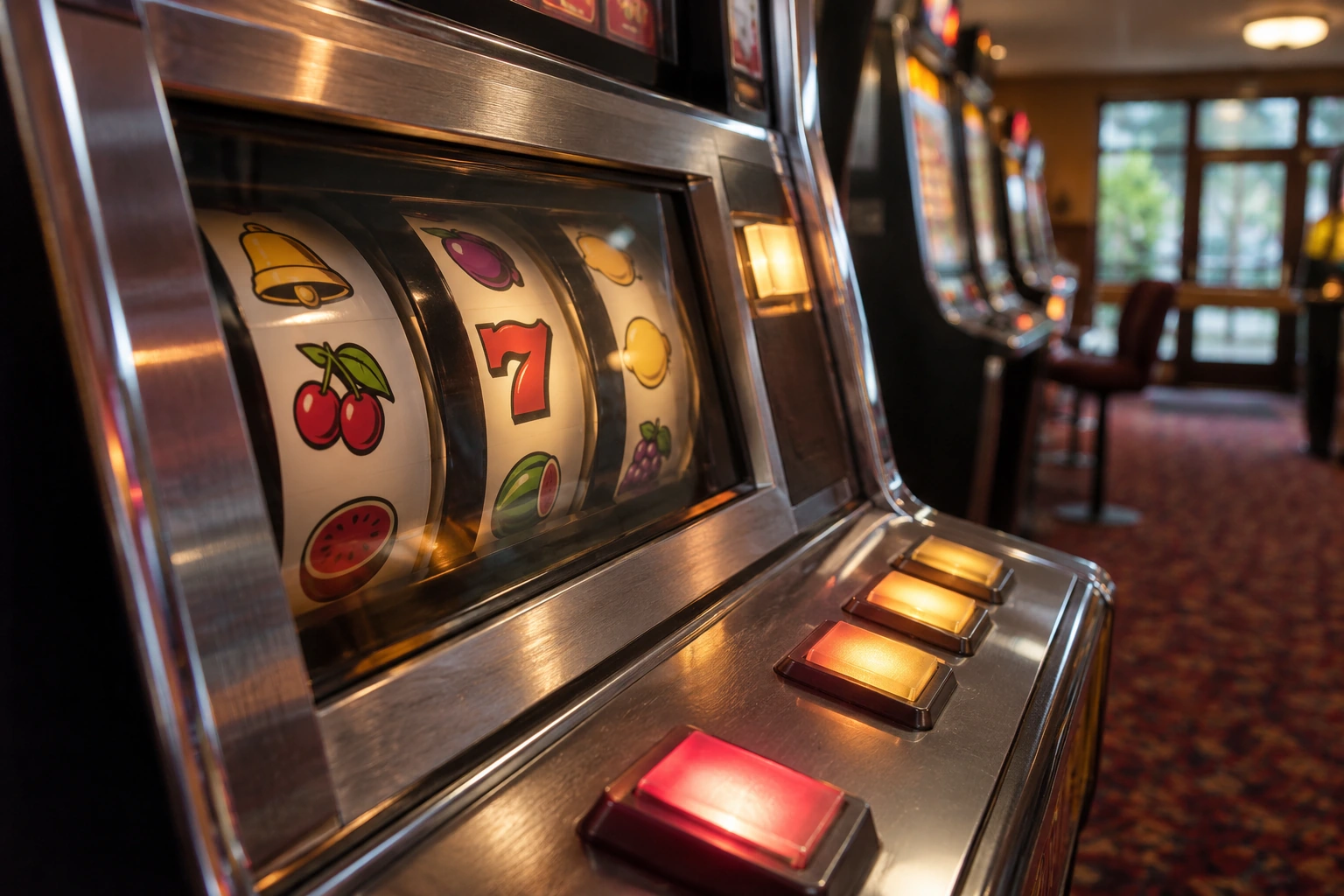
| slot machine | Multiplier and bonus interaction | What makes it distinct |
|---|---|---|
| The Dog House Multihold — Pragmatic Play | 2× and 3× wild multipliers are added when several join one winning combination. Free spins introduce sticky wilds and additional unlockable grids. | Wild-based, additive multipliers |
| Buffalo King — Pragmatic Play | During free spins, wilds carry 2×, 3× or 5× values. Multiple wilds participating in the same win have their multipliers multiplied together. | Wild-based, multiplicative stacking |
| Gates of Olympus — Pragmatic Play | Winning symbols pay anywhere across tumbling reels. Multiplier symbols can reach 500×, and winning multiplier values are accumulated during the free-spins feature. | Collected multipliers associated with winning tumbles |
| Sweet Bonanza — Pragmatic Play | Four or more scatters trigger free spins; multiplier symbols of 2×–100× can appear during the bonus and their values are added at the end of a tumble sequence. | Bonus-only multiplier symbols on a pay-anywhere grid |
| Gonzo's Quest — NetEnt | Avalanche wins increase the multiplier, with the base game capped at 5× and the Free Falls round reaching 15×. | A multiplier that grows through successive avalanches |
| Sugar Rush 1000 — Pragmatic Play | Winning cluster positions develop multipliers that double on repeat hits, up to 1,024×. Marked spots persist during free spins. | Persistent grid-position multipliers |
The Dog House adds eligible 2× and 3× wilds to 5×; Buffalo King multiplies them to 6× during free spins. Gonzo's Quest increases its factor after successive avalanches. Sugar Rush 1000 instead builds multipliers on repeat-winning grid positions. Gates of Olympus and Sweet Bonanza each have their own multiplier-collection rules for tumbling wins.
Bonus buys and ante bets: different costs, different questions
Where available, a bonus buy (feature buy) charges a set multiple of the usual stake for direct bonus entry. At 100× a £1 reference stake, the purchase costs £100. It buys entry under the game's rules, not a £100 return, profit or guaranteed multiplier.
An ante bet or enhanced-stake mode charges more for regular spins in exchange for a stated adjustment, such as a greater chance of triggering free spins. A Super Spin may cost more again and introduce guaranteed feature symbols or changed multiplier conditions. Neither is a free upgrade.
A displayed 96% base-game RTP does not establish the RTP of a 100× feature buy. Purchase prices, theoretical returns, payout distributions and availability in the UK may differ by game version. The cost is known in advance; the amount returned is not.
RTP, volatility and maximum win: what the big numbers miss
Return to player (RTP) is a mathematical average across very large numbers of wagers. At 96% RTP, the theoretical return is £96 per £100 staked in aggregate, leaving a 4% house edge. That is not a forecast for one £100 session. Versions and wager modes can publish different figures.
Volatility describes how unevenly prizes are distributed. High-volatility slot machines can concentrate much of their theoretical return in rare bonuses or large multipliers, with long stretches of small or zero wins. Hit frequency counts winning results, not profitable spins: a £0.20 hit on a £1 stake is still a £0.80 net loss.
Maximum win, often listed as 5,000× or 25,000× the stake, is a payout ceiling, not the probability of hitting it. A 1,000× symbol still needs a qualifying prize and cannot override the game's cap.
A fixed jackpot pays a set prize; a progressive jackpot may grow as qualifying wagers feed its pool. Neither works like a progressive multiplier, which increases a factor applied to a win. Jackpot eligibility still follows the stated game mode, symbols and conditions.
A correctly implemented random number generator (RNG) determines chance outcomes under the game's mathematics. Previous losses do not make the next independent spin due for free spins. A missed scatter or nearly filled Hold & Win grid offers no prediction either. Sticky wilds and other persistent states last only for the defined feature, not for unrelated future spins.
How to interpret any slot machine's bonus rules
A paytable settles six details that determine whether a displayed multiplier affects a prize:
- Pay structure: Is the win based on paylines, ways to win, pay-anywhere symbols or connected clusters? What counts as a base win?
- Trigger conditions: Which scatter, wild, collector or bonus symbols are required, and on which reels may they land?
- Multiplier scope: Does a displayed value affect one line, one position, the entire tumble sequence or every win in a free-spins round?
- Stacking and expiry: Do simultaneous values add or multiply? Does the meter reset on a non-winning spin, after the cascade or at the end of the feature?
- Feature cost and limits: What is the total stake, bonus-buy price, retrigger limit and maximum payout? Do bonus modes display separate RTP values?
- Exact game version: Do the RTP, feature rules and restrictions match the version actually offered, rather than a review of an older title?
Two games with the same advertised multiplier may pay different amounts. The qualifying prize, activation rule, extra stake and reset point matter more than the headline value.
Multipliers and bonuses in Great Britain
In Great Britain, check the operator against the Gambling Commission public register and read the specific game rules. Published return figures, payout schedules, jackpot eligibility and player controls can differ between games and versions. A mathematical model or laboratory test does not establish that an operator is licensed.
Mathematical probabilities and expected returns cannot predict an individual session or eliminate the risk of losing money.
Questions that bonus screens rarely answer
Does a 100× multiplier mean 100 times my bet?
Only when the rules apply it to the whole stake. A 100× multiplier on a £0.10 qualifying prize makes £10 before other eligible wins or caps.
Can a free-spins feature pay nothing?
Yes. Extra spins are random evaluations, not a promise of paying symbols, multiplier wins or recovery of earlier paid spins.
Do two multiplier wilds always multiply together?
No. The Dog House Multihold adds eligible wild values, while Buffalo King multiplies them during free spins. Elsewhere, each wild may affect only its own winning combination.
Are bonuses more likely after a long run without one?
Past losses do not improve the chance of a bonus on an independent spin. A meter that retains progress is a separate mechanic governed by explicit rules.
Does buying a bonus improve the RTP?
Not automatically. Direct entry can have its own published RTP and payout distribution. Paying for a feature guarantees neither profit nor a positive expected return.
What is the difference between a multiplier and a bonus?
A multiplier scales an eligible prize; a bonus changes playing conditions or grants game events. Free spins with an increasing multiplier that persists across the round do both.
If a credited result seems smaller than its multiplier, the paytable explains why. Pay structure, multiplier scope, stacking method, bonus trigger, reset point and payout limit govern settlement. None of those rules predicts the next random outcome.