
A game with a 96% return to player (RTP) has a 4% house edge. Those figures describe the expected return and loss across many wagers. They cannot tell you what the next spin or hand will pay.
The distinction between money deposited and money wagered changes the calculation. House edge applies to every stake, including winnings bet again. A £100 deposit can generate more than £100 in turnover, and 96% RTP never promises a £96 withdrawal.
What are RTP and house edge?
Return to player is the percentage of stakes a game is designed to return as prizes over a large number of rounds. Slots generally display it in the rules or game-information panel.
House edge, or house advantage, is the expected loss as a percentage of the amount staked. The term is common in roulette, blackjack, baccarat and other table games. For a standard house-banked wager, RTP and house edge add up to 100%:
House edge (%) = 100% − RTP (%)
RTP (%) = 100% − house edge (%)
| Theoretical RTP | House edge | Expected loss per £100 of turnover |
|---|---|---|
| 98% | 2% | £2 |
| 96% | 4% | £4 |
| 94% | 6% | £6 |
| 90% | 10% | £10 |
The edge isn't a fee on every round. A bet might pay nothing, return part of its stake or produce a prize larger than the stake.
How the mathematics is calculated
Every outcome has a probability and a prize. To calculate RTP, weight each payout by its probability, add the results and divide by the stake. Developers record this probability model in a mathematical specification, sometimes called a PAR sheet.
RTP = [sum of (outcome probability × total payout)] ÷ stake × 100%
Expected value (EV) counts net winnings or losses rather than the full prize. A lost £1 bet contributes −£1; a winning bet contributes its profit after the original stake is deducted. When EV is negative, the house edge expresses that expected loss as a percentage of the stake.
A European roulette example
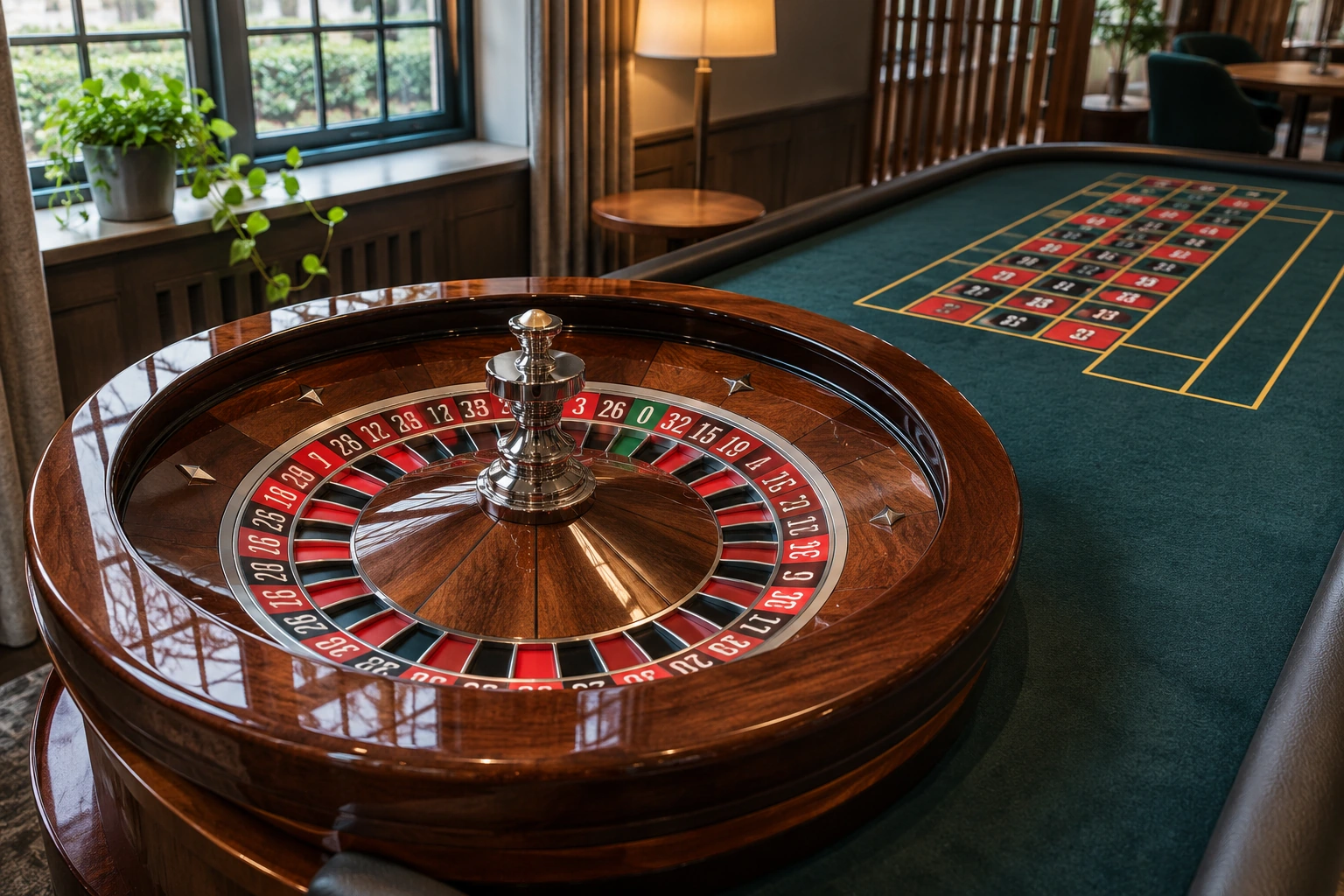
European roulette has 37 pockets: 1 to 36 and a single zero. A £1 straight-up bet hits its number with probability 1/37 and usually pays 35 to 1. A win returns £36, including the original stake.
RTP = (1/37 × £36) ÷ £1 = 97.30%
House edge = 100% − 97.30% = 2.70%
American roulette adds a second zero but keeps the usual 35-to-1 straight-up payout. With 38 pockets, RTP falls to 94.74% and the house edge rises to 5.26%, almost twice the European figure. Earlier spins have no effect on the next result.
Slots use the same arithmetic across many more possible outcomes: weighted virtual reels, paylines or ways to win, multipliers and bonus features. The reel animation reveals little about the probabilities behind those returns.
Why turnover matters more than the deposit
Turnover counts every stake, including bets funded by previous wins. Two hundred spins at £2 generate £400 of turnover, whatever the initial deposit.
Use the house edge as a decimal in the calculation: 4% becomes 0.04.
Expected loss = total turnover × house edge
At 96% RTP, 200 £2 spins have an expected loss of £16; at 94%, the figure is £24. Both assume the quoted game settings, a constant stake and all 200 spins being played. Neither predicts the closing balance.
On £1,000 of turnover, the expected loss is £20 at 98% RTP, £40 at 96% and £60 at 94%. Moving from 94% to 96% reduces expected loss by £20. It does not guarantee a better result in any one session.
A bankroll is the money available to withstand losing runs. A £20 win that is staked again increases turnover without another deposit. Faster spins or higher stakes increase the amount exposed to the house edge each hour, even though RTP stays the same.
Why actual returns can be far above or below RTP
Theoretical RTP comes from the game's design; actual RTP comes from recorded wagers and prizes. A short session, even one with thousands of rounds, need not match the mathematical target.
Variance explains much of that gap. Low-volatility slots tend to pay smaller prizes more often; high-volatility games put more of their return into rarer large awards. Both can have 96% RTP. Standard deviation measures how widely results spread around their expected value. No fixed number of spins forces the actual return to match the quoted percentage; greater volatility makes short samples less informative.
Hit frequency counts rounds with a defined winning result, not how much those wins pay. A return smaller than the original stake can still count as a hit. A 30% hit frequency does not mean a 30% RTP or a 30% chance of finishing in profit.
The law of large numbers describes how averages behave as more observations accumulate. It does not make a slot repay previous losses. Independent RNG spins have no memory: a long dry spell does not make a jackpot “due”. Expecting otherwise is the gambler's fallacy.
A losing run can exhaust a finite bankroll before observed returns come close to theoretical RTP. A higher return reduces expected cost per stake, but not short-term swings or risk of ruin.
What determines a slot's RTP?
A slot's payout model draws on more than the symbols visible in the window. Its main components include:
- Reels and symbol weighting: virtual reel positions determine how often particular symbols and combinations can occur.
- Paytable and winning patterns: paylines, ways-to-win mechanics and prize values determine what each result pays.
- Wilds, scatters and multipliers: special symbols can alter combinations, trigger features or change prize sizes.
- Free spins, respins and bonus rounds: feature frequency and award distributions contribute to total expected return.
- Fixed or progressive jackpots: rare top prizes may account for a meaningful part of theoretical RTP; a linked jackpot can have separate contribution and eligibility rules.
The base-game RTP may exclude bonus features or jackpot contributions that appear in an overall figure. An optional bonus buy can also have separate costs and an effective RTP of its own. The percentage must match the mode actually played.
A random number generator (RNG) selects outcomes from the game's programmed probability distribution. Random does not mean equally likely: virtual reels can weight symbols differently without making individual draws predictable. Independent testing checks both the RNG and its mapping to game results.
Can two versions of the same slot have different RTPs?
Yes. The same slot can be supplied with multiple approved RTP configurations, identical graphics and different prize probabilities. A review quoting 96.5% may not match a live version set to 94%.
Catalogues list developers such as NetEnt, Pragmatic Play, Play'n GO and Evolution. Their advertised figures and third-party reviews cannot replace the RTP displayed in the live game.
Check the live game version and its displayed theoretical RTP, paytable and jackpot or bonus-buy rules. A casino-wide payout average won't identify that slot's return.
For a game offered both free and for money on the same website, Gambling Commission RTS 6 requires the free version to use the same rules and reasonably represent the likelihood of winning and prize distribution. Similar graphics alone do not establish that two offerings are equivalent.
House edge across casino games and bets
Slot RTP depends on the configuration; table-game edge depends on a particular bet and ruleset. The figures are benchmarks, not claims about availability in Great Britain.
| Game or bet | House edge | Equivalent RTP | Conditions |
|---|---|---|---|
| European roulette | 2.70% | 97.30% | Single-zero wheel; ordinary straight-up bet |
| American roulette | 5.26% | 94.74% | Double-zero wheel; ordinary straight-up bet |
| French roulette, la partage | 1.35% | 98.65% | Even-money bets with the half-loss rule on zero |
| Baccarat: Banker | 1.06% | 98.94% | Eight-deck punto banco; 5% commission on Banker wins |
| Baccarat: Player | 1.24% | 98.76% | Eight-deck punto banco; standard rules |
| Baccarat: Tie | 14.36% | 85.64% | Eight-deck punto banco; tie pays 8 to 1 |
| Craps: Pass Line | 1.41% | 98.59% | Standard pass-line bet, excluding free-odds wagers |
| Blackjack | Around 0.5% | Around 99.5% | Favourable rules and correct basic strategy; varies by table |
| Video poker: 9/6 Jacks or Better | About 0.46% | About 99.54% | Full-pay paytable with optimal play |
| Online slots and keno | Game-specific | Game-specific | Check the exact game's configured return and prize schedule |
The Wizard of Odds house-edge calculations list these benchmarks, not availability in Great Britain.
The same game can contain bets with very different edges. Baccarat's Banker, Player and Tie wagers are priced differently. Roulette's la partage rule reduces the edge on qualifying even-money bets, not straight-up numbers. In craps, additional odds bets can have zero edge while the Pass Line wager retains its own.
Strategy, side bets and bonuses change the comparison
In blackjack, basic strategy uses the player's cards and dealer's upcard to minimise expected loss under a given ruleset. Deck count, soft-17 rules, doubling, splitting, surrender and a 3:2 rather than 6:5 blackjack payout change the calculation. A benchmark edge near 0.5% assumes favourable rules and accurate play.
Video poker also depends on the paytable and which cards are held: full-pay 9/6 Jacks or Better is not equivalent to a reduced-pay version. Changing stake size, alternating roulette colours or using the Martingale progression leaves an independent wager's edge unchanged. Those systems alter the size and timing of bets, not the odds.
Side bets and insurance often have a different edge from the main wager. Live dealers do not change the rules or payouts that determine it.
Casino bonuses need a separate calculation. Wagering requirements, contribution rates, maximum bets, cash-out restrictions, transaction fees and currency conversion can affect their net value without changing the game's RTP. A “200% bonus” describes an offer, not a 200% return.
Theoretical RTP, actual RTP and independent testing
For a reporting period, observed return is calculated as:
Actual RTP = total prizes paid ÷ total stakes wagered × 100%
A game that pays £473,000 on £500,000 of stakes reports 94.6% actual RTP for that period. It may still be designed for a different return. Theoretical settings, sample size, volatility, jackpot events and the reporting window are needed to assess the difference.
The UK Gambling Commission's technical guidance explains actual RTP and why acceptable statistical variation depends on how much play was recorded and how volatile the game is. An observed RTP outside the expected statistical range may warrant investigation; a shortfall alone does not prove manipulation.
Laboratories such as eCOGRA test mathematical models, simulations and RNG behaviour against intended results. A game-testing report concerns the version tested. It does not authorise a casino to serve customers in Great Britain or certify a different game build.
A casino-wide payout rate pools several games and betting patterns; an account history covers one person's wagers. Neither identifies a particular game's theoretical RTP.
RTP transparency and online gambling in Great Britain
In Great Britain, check the operator against the Gambling Commission public register and read the specific game rules. Published return figures, payout schedules, jackpot eligibility and player controls can differ between games and versions. A mathematical model or laboratory test does not establish that an operator is licensed.
Mathematical probabilities and expected returns cannot predict an individual session or eliminate the risk of losing money.
How to interpret the number shown in a game
- Identify the exact bet. A game's headline RTP may not apply to a side bet, bonus buy or alternative betting mode.
- Check the live rules and paytable. Match the stated percentage to the deployed game version, payout schedule, jackpot conditions and any separate feature RTP.
- Convert RTP to house edge. Subtract it from 100%. This translates a return figure into an expected cost per unit staked.
- Use realistic turnover. Multiply the edge by the total of all planned stakes, not merely the deposit. Treat the result as an expectation, never a session forecast.
- Keep outcome risk separate. Volatility, hit frequency, jackpot concentration and available bankroll determine how widely actual results may fluctuate.
- Separate mathematics from operator claims. Testing evidence, legal status, game availability, payment conditions and player protections require their own verification.
For equal turnover, 97% RTP costs less in expectation than 95%, provided both figures apply to the versions compared. A short session can still go either way.
RTP and house edge: common questions
Is 96% RTP good?
A 96% RTP means a 4% theoretical edge. Whether that is favourable depends on the alternatives. It doesn't show how likely a session is to finish in profit.
Does a 96% RTP mean I get £96 back from £100?
No. £100 is a deposit, not necessarily £100 of turnover. Winnings may be staked again, taking total bets well above the deposit; a losing run can end play earlier. The actual payout need not resemble 96%.
Can a higher RTP guarantee a win?
No. Higher RTP lowers the average expected loss over the same turnover. It gives no minimum payout, guaranteed profitable session or schedule for a jackpot.
Can I improve a slot's RTP with a betting strategy?
Changing stake patterns or switching after losses cannot alter the mathematical return of an independent slot. Playing a different approved version or mode means facing a different probability model, not exploiting a timing pattern.
Is a 100% RTP game risk-free?
No. With zero house edge, short-run losses remain possible. Fees or bonus rules can still reduce net returns.
Is a low house edge proof that an online casino is safe?
No. A low edge cannot establish licensing, reliable withdrawals or fair dispute handling. RNG tests and safer-gambling safeguards require separate checks.
Gambling can cause harm. For information about gambling support in Great Britain, see the NHS gambling support guidance.